
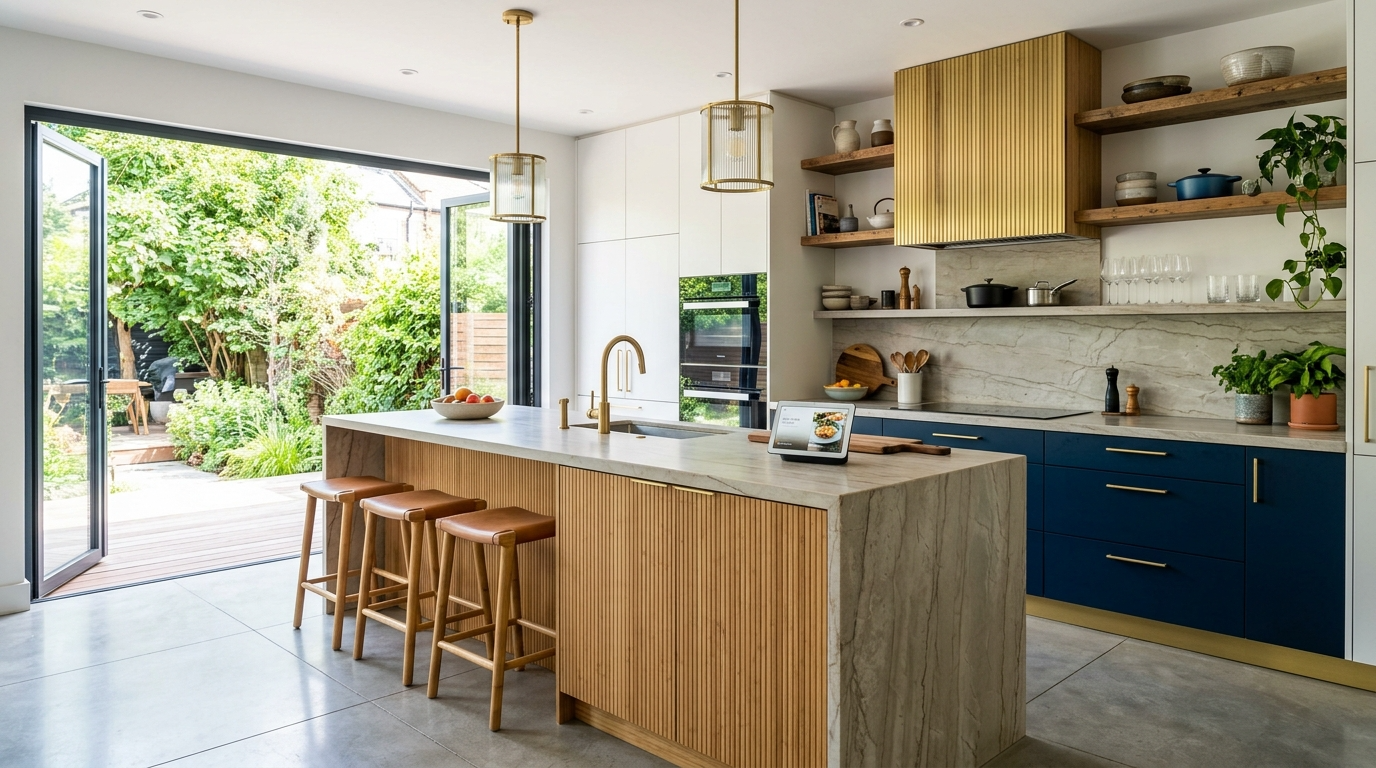
Kitchen Design Trends for 2026
If you’re planning a remodel in the Houston area, our kitchen design services in Missouri City can help you plan the layout, cabinetry, lighting, and finishes before construction begins. In 2026, the strongest kitchen trends are not just about style, but about how the space works day to day.
Sustainable Materials and More Selective Material Choices
Sustainability is still part of the conversation, but the focus has become more practical. Instead of treating every surface as a statement about eco-conscious design, many homeowners are being more selective about where reclaimed, recycled, or renewable materials make sense.
Reclaimed wood still has a place, especially on shelving, beams, vent hoods, or furniture-style island details. Bamboo remains an option for homeowners who want a renewable material, though it works better in some applications than others. Recycled surfaces are also getting more attention, especially when clients want texture, variation, and something less predictable than a standard quartz slab.
Cork is another material that comes up more often now, particularly for flooring. It has a softer feel underfoot and brings a different texture into the room. It is not the right choice for every kitchen, but it reflects a broader move toward natural materials and more thoughtful surface selection.
Smart Kitchen Technology That Feels Useful
Smart kitchen features are becoming more common, but homeowners are less interested in novelty and more interested in what actually makes the room easier to use. That usually means appliances and controls that solve small daily problems rather than adding more complexity.
Current examples include refrigerators with better organization tools, ovens that can be monitored remotely, lighting controls that adjust by zone, and charging built into drawers or island seating areas. Induction cooktops are also getting more attention because they offer better temperature control and a cleaner look than a traditional gas range.
The best technology choices still depend on how the kitchen is used. A client who cooks often may care about ventilation, appliance performance, and prep lighting. A busy family may care more about easier cleanup, better storage, and appliances that simplify weeknight routines.
Open Kitchen Layouts With Better Space Planning
Open kitchens are still a common choice, especially in homes where the kitchen connects directly to the dining and living areas. What matters now is not just opening up the room, but planning it well enough that the space still works.
That means paying closer attention to walkway clearance, island size, prep zones, stool spacing, and appliance placement. In many homes, the kitchen now has to support cooking, casual meals, conversation, and sometimes work or homework. The layout has to account for that from the beginning.
Open kitchens also need stronger finish coordination than closed-off spaces. Cabinet colors, flooring transitions, lighting, and sightlines all become more noticeable when the kitchen is visible from several rooms at once.
More Color, More Texture, and Less Flat Finishes
White kitchens are still being used, but they are no longer the default for every remodel. More homeowners are choosing warmer wood finishes, deeper cabinet colors, natural stone with visible movement, and tile that adds texture instead of disappearing into the background.
Painted cabinetry in green, blue, charcoal, taupe, and off-black tones continues to show up in both full kitchen remodels and smaller updates. On the hardware side, aged brass, antique brass, and mixed metal combinations are still popular because they layer well with wood, stone, and painted cabinetry.
The kitchens that feel strongest in this direction usually rely on contrast in a controlled way. That might mean stained white oak on the island with painted perimeter cabinets, or a quieter cabinet color paired with a backsplash that has more shape, variation, or surface texture.
Kitchen Islands That Handle More Than One Job
The island is still one of the most used parts of the kitchen. In many remodels, it needs to handle prep space, seating, storage, serving, and sometimes a sink, microwave drawer, beverage fridge, or secondary dishwasher.
That is why island design has become more detailed. Homeowners are asking for deeper drawers, better trash pull-outs, built-in outlets, charging access, and seating layouts that actually fit the household using the room. In larger kitchens, the island is also helping define work zones so the space feels organized instead of spread out.
A good island is not just large. It has to be proportioned correctly for the room and built around how the kitchen will be used every day.
Vintage Details Used in Smaller, More Controlled Ways
Vintage influences are still part of kitchen design, but usually through specific details rather than a full retro look. Homeowners are mixing a few older elements into cleaner cabinetry and updated layouts instead of trying to recreate a period kitchen.
That can include bridge faucets, furniture-style island legs, unlacquered brass, framed cabinet fronts, latch hardware, or patterned tile used in a pantry, backsplash, or secondary area. These choices add character, but they work best when they are balanced with simpler finishes elsewhere in the room.
Used carefully, those details can keep a kitchen from feeling too plain or overly polished. Usually, a few well-placed references do more than trying to make every part of the room feel vintage.
Minimalist Kitchens With More Warmth
Minimalist kitchens are still popular, but the look has shifted. Instead of very stark rooms with flat white finishes and almost no visual variation, many homeowners want a cleaner kitchen with fewer visual breaks, less countertop clutter, and more hidden storage.
That often means slab or low-profile cabinet fronts, appliance panels, appliance garages, integrated storage, and simpler hardware choices. The overall effect is cleaner, but the room still needs enough texture to avoid feeling cold.
Wood cabinetry, natural stone, softer paint colors, and layered lighting are doing a lot of the work here. They help the kitchen stay restrained without feeling stripped down.
Stronger Indoor and Outdoor Connection
In homes where the layout allows for it, kitchens are connecting more directly to covered patios, outdoor dining areas, and backyard entertaining spaces. This is happening through larger doors, stronger sightlines, and material choices that relate more closely from inside to outside.
Outdoor kitchens are also becoming more complete. Instead of stopping at a grill and a small counter, many homeowners now want refrigeration, prep space, storage, and surfaces that can handle regular use. Even when the kitchen remains fully indoors, clients often want the room to feel more connected to the yard through windows, doors, and natural light.
This idea works best when the architecture supports it. When it does, it can make the kitchen feel more open and more connected to the rest of the home.
What These Kitchen Design Trends Mean for 2026
The kitchen trends worth paying attention to in 2026 are the ones that improve layout, storage, lighting, and daily use. Some homeowners want warmer wood tones, painted cabinetry, and layered finishes. Others want a cleaner kitchen with flatter cabinet profiles, concealed storage, and simpler material transitions.
Not every trend belongs in every project. The right direction depends on the home, the architecture, the budget, and how the kitchen is actually used. That is usually where the design work matters most.
If you’re planning a kitchen remodel, it helps to make those decisions early, before cabinetry, countertops, tile, lighting, and fixtures are selected one by one. A clear kitchen design plan makes the entire process more organized and usually leads to better results.